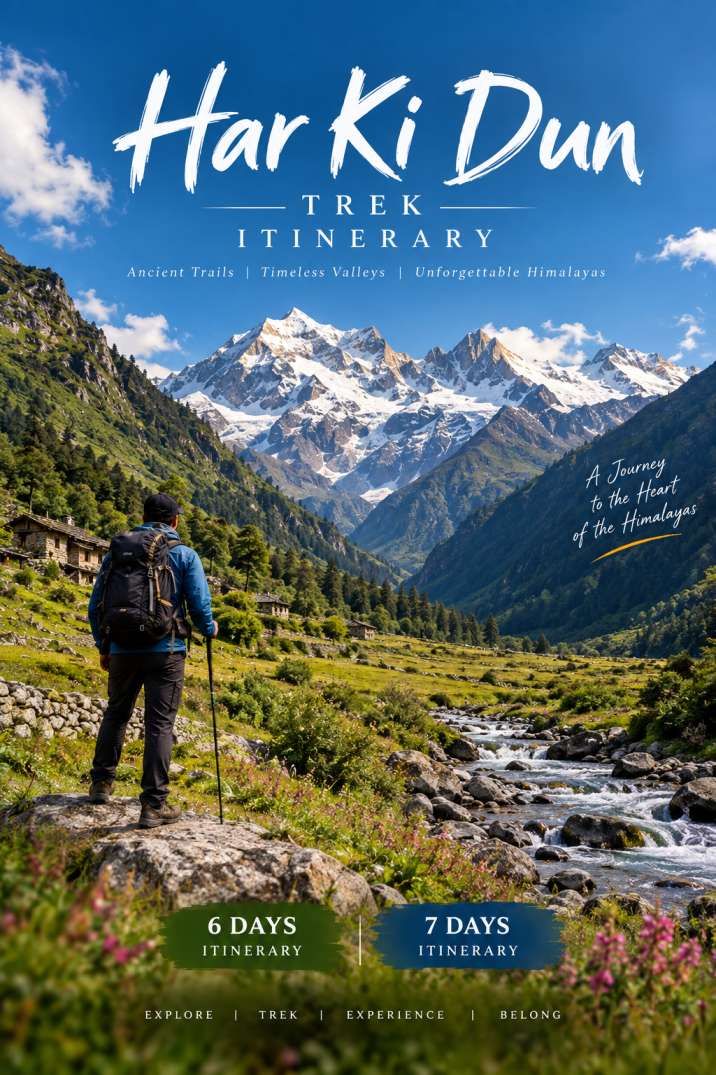
Nestled in the heart of Uttarakhand’s Garhwal Himalayas, the Har Ki Dun trek stands as one of India’s most enchanting mountain adventures. Often called the “Valley of Gods,” this ancient trail winds through 2,000-year-old villages, dense pine forests, and alpine meadows before revealing the majestic Har Ki Dun valley at 11,700 feet. Whether you’re searching for a detailed Har Ki Dun trek itinerary or planning your first Himalayan expedition, this comprehensive guide provides everything you need—from day-wise breakdowns to altitude charts and expert tips.
If you’re ready to book your adventure, explore our Har Ki Dun Trek Package for complete inclusions, pricing, and departure dates.
Why Choose the Har Ki Dun Trek?
The Har Ki Dun valley holds a special place in Himalayan mythology. Legend says the Pandavas ascended to heaven via Swargarohini—the very peak that dominates this trek’s skyline. Beyond mythology, the trek offers:
- Mythological Significance: Ancient Osla village with its 5,000-year-old Duryodhana temple
- Diverse Landscapes: From Govind National Park’s dense forests to glacial valleys
- Accessibility: Suitable for beginners yet rewarding for experienced trekkers
- Year-Round Beauty: Spring blooms, summer greenery, or autumn snows
Har Ki Dun Trek Quick Facts
| Attribute | Details |
|---|---|
| Duration | 7 Days (6 Nights) |
| Trek Distance | ~46 km walking |
| Maximum Altitude | 11,700 ft / 3,566 m |
| Difficulty Level | Easy to Moderate |
| Base Camp | Sankri (6,400 ft) |
| Best Seasons | April-June & September-November |
| Rail Head | Dehradun |
| Nearest Airport | Jolly Grant Airport (28 km from Dehradun) |
Detailed 7-Day Har Ki Dun Trek Itinerary
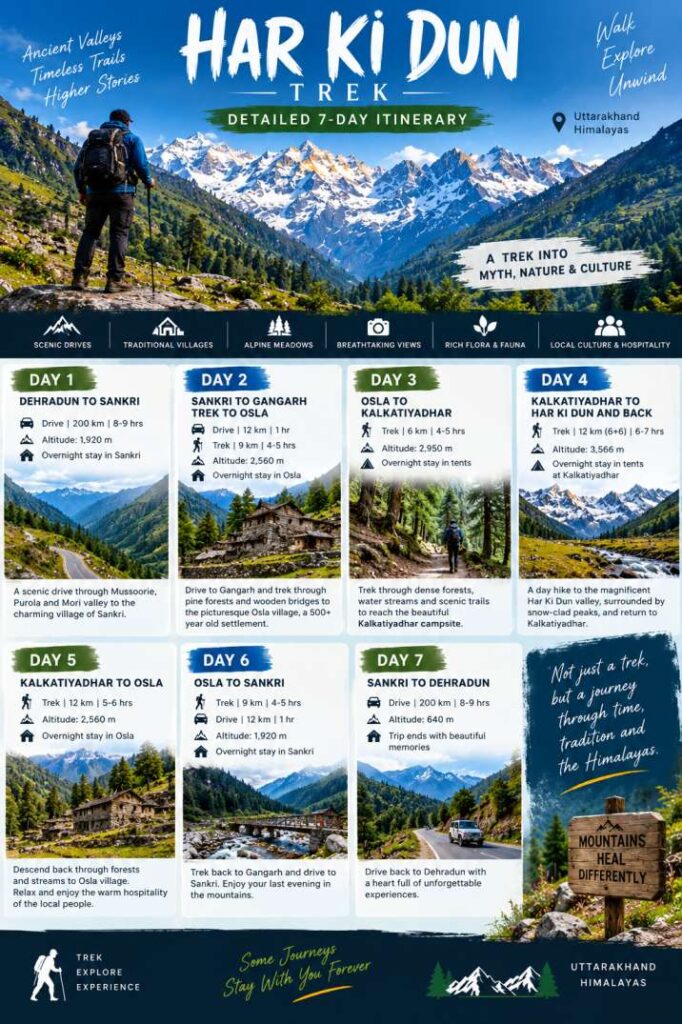
This day wise Har Ki Dun trek plan follows the classic Sankri-to-Sankri route, optimized for proper acclimatization and maximum enjoyment.
Day 1: Dehradun to Sankri (Base Camp)
- Distance: ~200 km by road
- Duration: 8-10 hours drive
- Altitude: 6,400 ft / 1,950 m
- Accommodation: Guesthouse/Homestay
Your journey begins with an early morning departure from Dehradun, winding through Mussoorie’s hills and the Yamuna valley. The route passes through Purola and Mori before entering Govind National Park’s dense forests. Arrive in Sankri by evening—this charming village serves as the gateway to multiple Himalayan treks. Spend the evening acclimatizing and exploring local markets.
Pro Tip: Arrange your Dehradun arrival at least one day prior to avoid travel delays.
Day 2: Sankri to Taluka to Seema
- Trek Distance: ~12 km
- Walking Time: 6-7 hours
- Altitude Gain: 6,400 ft → 8,200 ft
- Accommodation: Riverside camping
After breakfast, drive 12 km to Taluka (or Dharkot, depending on road conditions). Begin trekking alongside the gushing Supin River through dense deodar and pine forests. The trail passes through Gangar village where you can spot traditional wooden architecture. Cross wooden bridges and enjoy packed lunch by the riverside before reaching Seema campsite.
Highlight: First views of Swargarohini peaks through forest clearings.
Day 3: Seema to Osla to Har Ki Dun
- Trek Distance: ~11 km
- Walking Time: 5-6 hours
- Altitude Gain: 8,200 ft → 11,700 ft
- Accommodation: Valley camping
Today’s trail crosses the iconic Seema suspension bridge over the Supin River. Pass through Osla village—famous for its ancient Someshwar temple dedicated to Duryodhana. The path climbs steadily through Kalkattiyadhar ridge, offering panoramic views of Bandarpoonch and Black Peak. Enter the legendary Har Ki Dun valley by afternoon—a natural amphitheater surrounded by snow-capped giants.
Highlight: Reaching the “Valley of Gods” with Swargarohini-I, II, and III dominating the skyline.
Day 4: Har Ki Dun Valley Exploration
- Activity: Valley exploration and acclimatization
- Optional Trek: Jaundhar Glacier viewpoint (~4 km)
- Altitude: 11,700 ft
Dedicate this day to exploring the valley’s hidden gems. Visit the Jaundhar Glacier snout, walk to Marinda Tal (a high-altitude lake), or simply soak in the 360-degree mountain views. This rest day is crucial for acclimatization and photography. Birdwatchers can spot Himalayan monals, griffons, and snow pigeons.
Highlight: Sunrise over Swargarohini—an unforgettable golden-hour spectacle.
Day 5: Har Ki Dun to Seema
- Trek Distance: ~11 km
- Walking Time: 5-6 hours
- Altitude Loss: 11,700 ft → 8,200 ft
- Accommodation: Riverside camping
Begin your descent after breakfast, retracing the path through Osla. The downhill trek is gentler on the lungs but demanding on the knees—use trekking poles for stability. Stop at Osla village to interact with locals and purchase handmade woolens. Reach Seema campsite by afternoon for a relaxed evening by the Supin River.
Day 6: Seema to Taluka to Sankri
- Trek Distance: ~12 km
- Walking Time: 6-7 hours + road transfer
- Altitude Loss: 8,200 ft → 6,400 ft
- Accommodation: Guesthouse/Homestay
Complete the final trekking stretch through familiar forests and meadows. From Taluka, drive back to Sankri. Celebrate your achievement with a hot meal and share stories with fellow trekkers. This evening is perfect for stargazing—Sankri’s clear skies offer brilliant views of the Milky Way.
Day 7: Sankri to Dehradun
- Distance: ~200 km by road
- Duration: 8-10 hours drive
After breakfast, bid farewell to the mountains and drive back to Dehradun. Expect arrival by 6-7 PM. Book your onward journey (flights/trains) for the next day to accommodate potential road delays.
Alternative: Har Ki Dun Itinerary 6 Days
For trekkers with limited time, a Har Ki Dun itinerary 6 days format compresses the route by eliminating the dedicated exploration day (Day 4). While feasible for experienced trekkers, we recommend the 7-day format for proper acclimatization and safety. The 6-day variant requires:
- Starting trek days by 6 AM
- Skipping Jaundhar Glacier excursion
- Faster pacing between campsites
- Prior high-altitude trekking experience
Note: The 7-day itinerary remains our recommended choice for beginners and photographers seeking the full Valley of Gods experience.
Har Ki Dun Trek Route Map & Altitude Chart
Altitude (ft)
11,700 |                    [Day 3-4]
       |                   /        \
 8,200 |        [Day 2]---/          \---[Day 5]
       |       /                          \
 6,400 | [Day 1]----------------------------\[Day 6-7]
       |________________________________________
         Day 1   Day 2   Day 3   Day 4   Day 5   Day 6   Day 7
Route Summary: Dehradun → Sankri → Taluka → Seema → Osla → Har Ki Dun → Return via same route
Best Time for Har Ki Dun Trek
| Season | Months | Conditions | Highlights |
|---|---|---|---|
| Spring | April-June | 10°C to 20°C | Blooming flowers, clear trails, lush greenery |
| Autumn | September-November | 5°C to 15°C | Clear skies, snow-capped peaks, stable weather |
| Winter | December-March | -5°C to 5°C | Snow trek (advanced), closed post-December |
Avoid: July-August (monsoon) due to landslides and trail closures.
Difficulty Level & Fitness Requirements
The Har Ki Dun trek is classified as easy to moderate, making it ideal for beginners with basic fitness. Key challenges include:
- Daily Walking: 5-7 hours on uneven terrain
- Altitude Gain: Gradual ascent to 11,700 ft minimizes AMS risk
- Terrain: Rocky paths, wooden bridges, and steep sections near Osla
Preparation: Practice 5 km walks with a 10 kg backpack for 4-6 weeks pre-trek.
What to Pack for Har Ki Dun Trek
Essential Gear
- 65-75L backpack with rain cover
- Waterproof trekking shoes (broken-in)
- 5-6 warm layers including down jacket
- Thermal inners and woolen socks (4-5 pairs)
- Trekking poles and gaiters (for snow)
Documents & Permits
- Valid ID proof (Aadhar/Passport)
- Medical certificate (if required)
- Forest permits (arranged by TrekTonic Adventures)
Personal Items
- Sunscreen (SPF 50+), sunglasses, lip balm
- Water bottles (2L capacity) and hydration salts
- Personal medications and first-aid basics
- Power bank (no charging after Sankri)
Permits & Regulations
The Har Ki Dun trek passes through Govind Wildlife Sanctuary, requiring:
- Forest Entry Permit: Obtained at Sankri checkpost
- Camping Fees: Included in TrekTonic Adventures packages
- Environmental Fee: Mandatory for all trekkers
Important: The forest department closes the trek from mid-December to mid-March due to heavy snowfall.
How to Reach Sankri (Base Camp)
| Mode | Details |
|---|---|
| By Air | Fly to Jolly Grant Airport (Dehradun), then 200 km drive |
| By Train | Dehradun Railway Station, then shared taxi/bus to Sankri |
| By Road | Overnight Volvo from Delhi to Dehradun, then local transport |
Trektonic Advantage: We provide Dehradun-to-Dehradun transportation with experienced mountain drivers.
Why Book with TrekTonic Adventures?
- Certified Trek Leaders: AMC/BMC certified professionals
- Safety First: Oxygen cylinders, medical kits, and emergency protocols
- Quality Equipment: High-altitude tents, sleeping bags (-10°C rating)
- Sustainable Trekking: Leave-no-trace practices and local employment
- Transparent Pricing: No hidden costs, flexible rescheduling
Frequently Asked Questions
Q: What is the best Har Ki Dun itinerary for beginners?
The 7-day itinerary is perfect for beginners, allowing gradual acclimatization with only 5-6 hours of daily walking. The 6-day compressed format is suitable only for experienced trekkers.
Q: Can I do the Har Ki Dun trek in 5 days?
While physically possible, we strongly discourage it. Proper acclimatization requires 7 days to safely enjoy the trek and prevent altitude sickness.
Q: Is there mobile network on the trek?
BSNL and Jio work intermittently until Sankri. Beyond Taluka, expect complete digital detox—embrace the disconnection!
Q: What is the Har Ki Dun trek cost?
Costs vary by season and group size. Visit our package page for current pricing and inclusions.
Q: Are toilets available on the trail?
Campsites have dry toilet tents. Carry personal hygiene supplies and hand sanitizer.
Final Thoughts
The Har Ki Dun trek itinerary offers more than just a walking route—it’s a journey through time, mythology, and pristine Himalayan wilderness. Whether you choose the standard 7-day format or the compressed 6-day variant, proper preparation and the right trekking partner make all the difference.
At TrekTonic Adventures, we’ve guided hundreds of trekkers through this Valley of Gods safely and memorably. Ready to write your own Himalayan story?
Have questions about this itinerary? Drop them in the comments below or reach out via WhatsApp. Happy trekking!