
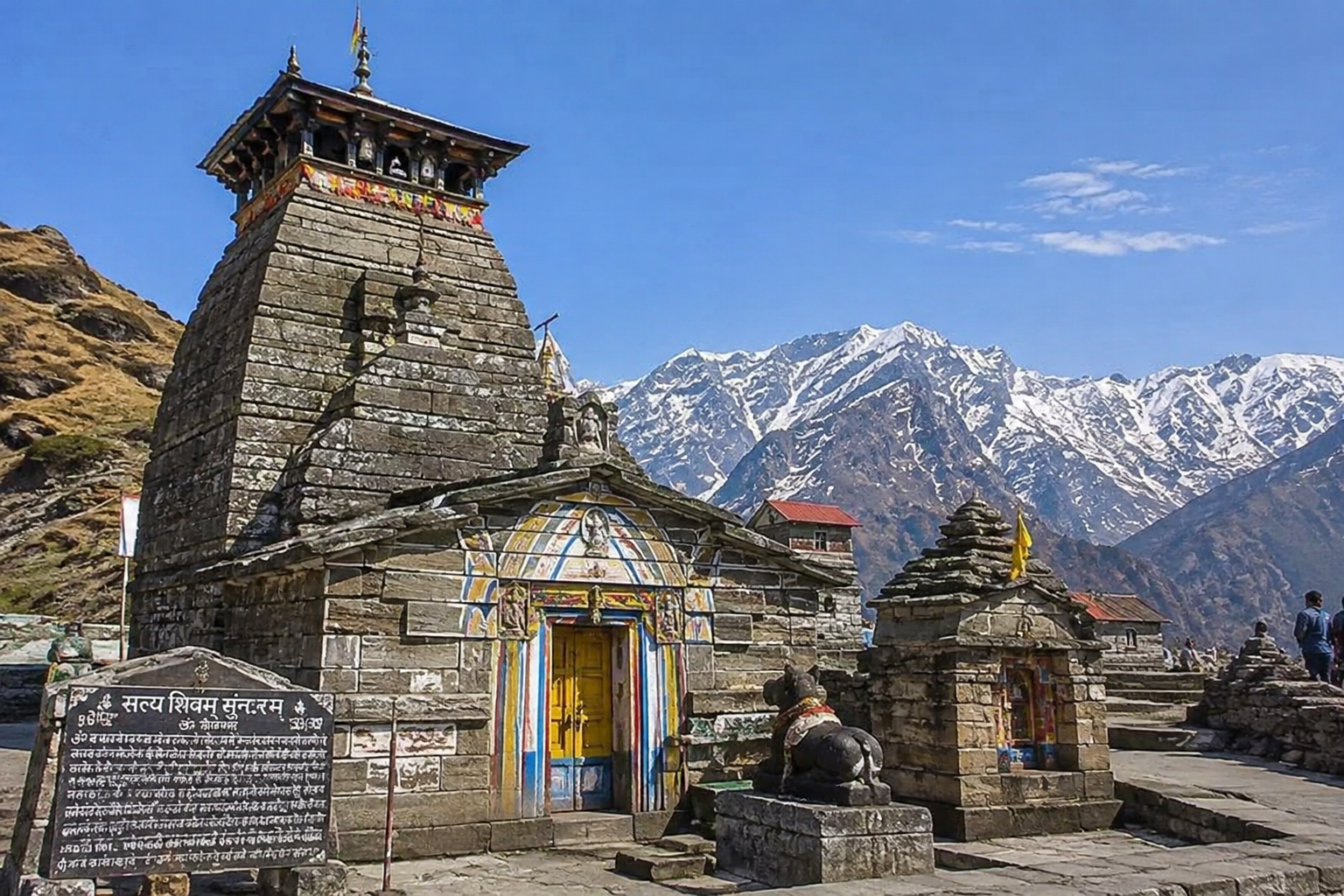
High above the meadows of Chopta, at close to 3,680 metres, sits a small stone shrine that locals and pilgrims consider the highest Shiva temple in the world. Tungnath Temple isn’t just a stop on a scenic trail — it’s one of the five Panch Kedar shrines of the Garhwal Himalayas, a place where mythology, mountain geography, and centuries of devotion meet at one windswept ridge.
For most visitors today, Tungnath is inseparable from the Chopta Tungnath trek — the short, popular hike that carries travellers from the pine and rhododendron forests of Chopta up to the temple courtyard and, for many, onward to the Chandrashila summit. But long before it became a trekking destination, Tungnath was a place of pilgrimage, rooted in stories that Garhwal has carried forward for generations.
This guide walks through what’s known about Tungnath’s history, the mythology attached to it, its geography and altitude, and the practical details — route, distance, timings, weather, and how to reach it — that you’ll need if you’re planning the trek yourself.
Tungnath Temple History at a Glance
- Location: Chopta, Rudraprayag district, Garhwal Himalayas, Uttarakhand
- Deity: Lord Shiva, worshipped here in the form of his arms (bahu)
- Altitude: Approximately 3,680 metres (12,073 ft) above sea level
- Significance: Third temple of the Panch Kedar, often described as the highest Shiva temple in the world
- Trek start point: Chopta
- Trek distance: Roughly 3.5 km one way from Chopta to the temple
- Best season: May–June and September–November
- Temple status: Open roughly six months a year; closed through winter due to heavy snow
The Ancient History of Tungnath Temple
Pinning an exact founding date on Tungnath is difficult, and any article that claims otherwise is guessing. What’s generally agreed upon by historians and temple scholars is that the shrine is old — most accounts place its stone structure at over a thousand years, built in the same North Indian Katyuri temple style shared by Kedarnath and Madhyamaheshwar. Some local traditions push the temple’s origins back much further, tying it to the Mahabharata period itself, but that timeline belongs to legend rather than documented history, and it’s worth holding the two apart.
What can be said with more confidence is that Tungnath has functioned as an active pilgrimage site for a very long time, and that it has always been treated as part of a larger network — the Panch Kedar — rather than a standalone shrine. Its stone construction, modest size (the sanctum can hold only a handful of people at once), and carved interior are consistent with other early Himalayan Shiva temples in the region.
Tungnath Temple and the Panch Kedar
Tungnath is the third of the five Panch Kedar temples, a group of Shiva shrines scattered across the Garhwal Himalayas: Kedarnath, Tungnath, Rudranath, Madhyamaheshwar, and Kalpeshwar. Together, these five temples are believed to mark the places where different parts of Shiva’s body are said to have appeared, according to a well-known legend rooted in the Mahabharata tradition.
At Kedarnath, it’s the hump; at Tungnath, the arms; at Rudranath, the face; at Madhyamaheshwar, the navel; and at Kalpeshwar, the hair. Pilgrims who complete all five shrines are said to undertake the full Panch Kedar Yatra, a journey considered spiritually significant within Shaivite tradition. Tungnath’s place in this circuit is a large part of why it draws pilgrims and not just trekkers — the temple is a religious destination first, and a trekking highlight second.
Mythology and Legends Associated with Tungnath
The Pandavas and Lord Shiva
The most widely told story connects Tungnath to the Pandavas, the five brothers of the Mahabharata. According to this tradition, after the Kurukshetra war, the Pandavas were troubled by the guilt of having killed their own kinsmen — including members of their extended family — in battle. Seeking absolution, they set out to find Lord Shiva and ask for his forgiveness.
The legend holds that Shiva, unwilling to grant an easy pardon, avoided them by taking the form of a bull and hiding in the Garhwal hills. When the Pandavas eventually recognised him, Shiva is said to have disappeared into the ground, only for parts of his body to resurface at five different spots in the mountains — the locations that would become the Panch Kedar temples. At Tungnath, tradition holds that his arms appeared, and a shrine was raised there in reverence.
It’s worth being clear about what this is: a story passed down through oral tradition and religious literature, not a historically verified event. Whether read as sacred history, allegory, or folklore depends on the tradition and the individual — but it’s the story that gives Tungnath its name and its place in the Panch Kedar circuit.
Why Tungnath Is Considered an Important Shiva Temple
Beyond the Pandava legend, Tungnath’s importance comes from a combination of factors: its position as part of the Panch Kedar, its extreme altitude (which itself is treated as spiritually significant — closer to the sky, closer to Shiva, in local belief), and its long, continuous history as a functioning temple rather than a ruin or monument. For Shaivite pilgrims, visiting Tungnath is understood to carry the same weight as visiting any other major Shiva shrine in the Himalayas, which is part of why the temple continues to draw a steady flow of devotees each season, alongside the trekkers.
Why Tungnath Temple Is Spiritually Significant
For pilgrims, the significance of Tungnath goes beyond the Pandava story. It’s considered one of the more physically demanding of the Char Dham and Panch Kedar shrines to reach, and that difficulty is itself treated as part of the pilgrimage — the effort of the climb is seen as part of the offering. The temple’s isolation, its high altitude, and the fact that it remains inaccessible for nearly half the year all contribute to a sense that reaching it is not meant to be easy.
For trekkers who aren’t visiting primarily for religious reasons, this context still matters. Understanding why the temple exists where it does, and why generations of pilgrims have made the climb, adds a layer of meaning to what might otherwise just be a scenic hike.
Where Is Tungnath Temple Located?
Tungnath Temple sits in the Rudraprayag district of Uttarakhand, in the Garhwal Himalayas, just below the Chandrashila summit. The nearest base for the trek is Chopta, a small meadow settlement often nicknamed the “Mini Switzerland of India” for its rolling grasslands and pine forests. Chopta itself lies between the Mandakini and Alaknanda river valleys, roughly 190–210 km from Rishikesh depending on the exact route taken.
Tungnath Temple Altitude and Geography
The temple stands at an altitude of approximately 3,680 metres (around 12,073 ft) above sea level, which is generally cited as making it the highest Shiva temple in the world. From the temple courtyard, and more dramatically from the Chandrashila ridge just above it, you get open views of major Himalayan peaks — Chaukhamba, Nanda Devi, Kedarnath, and Bandarpoonch are commonly visible on clear days.
The terrain around Tungnath is alpine: rhododendron and oak forest in the lower stretches near Chopta, giving way to open meadows (bugyals) and bare rock closer to the temple and summit. The thin air at this altitude is noticeable even on a short trek, which is worth keeping in mind regardless of how “easy” the distance looks on paper.
Chopta Tungnath Trek Route
The Chopta Tungnath trek is one of the most accessible high-altitude treks in Uttarakhand, which is a big part of its popularity with first-time trekkers, families, and pilgrims alike.
Chopta to Tungnath Distance
The trek from Chopta to Tungnath Temple covers roughly 3.5 km one way, on a mostly stone-paved trail. Trekkers who continue to Chandrashila add another 1.5 km beyond the temple, bringing the full one-way distance to about 5 km.
Trek Difficulty
The route is generally rated easy to moderate. The path to the temple is well-marked and paved for much of its length, with a steady rather than punishing incline. The stretch beyond Tungnath to Chandrashila is noticeably steeper and more exposed, and is where most people feel the altitude the most.
Approximate Trekking Time
Most trekkers take about 2 to 3 hours to reach the temple from Chopta, with the descent taking roughly 1.5 to 2 hours. If you’re continuing to Chandrashila, budget an extra 45 minutes to an hour each way from the temple.
What the Trail Is Like
The trail begins through forests of oak and rhododendron before opening into meadows as you gain height. Small tea stalls dot the lower and middle sections during peak season, though options thin out closer to the top. The final approach to the temple is rockier and steeper, and beyond it, the path to Chandrashila turns into an open, windswept ridge walk.
If you’d rather not plan the logistics — permits, guides, timing around the temple’s seasonal opening — on your own, a guided Chopta Tungnath Trek takes care of the route planning and local arrangements so you can focus on the walk itself.
Best Time to Visit Tungnath Temple
The Tungnath trek is best attempted in two windows: May to June, when rhododendrons are in bloom and the weather is mild, and September to November, after the monsoon clears and the skies are typically at their sharpest for mountain views. July and August are best avoided — the monsoon brings slippery trails and a higher risk of landslides on the approach roads. Winter (December to April) sees the temple closed entirely due to snow.
Tungnath Weather
Weather at this altitude changes quickly and shouldn’t be judged by conditions down in Chopta. In the May–June window, daytime temperatures on the trail are usually mild, though it can still turn cold and windy near the temple and summit. September–October tends to bring clearer skies and crisp air, with nights getting noticeably cold. Carrying layers is non-negotiable regardless of season — even a bright, sunny start can turn windy and cold within an hour, especially past the treeline.
Tungnath Temple Timings
The temple typically opens for the morning aarti around 6:00 AM, with darshan continuing until roughly 12:00 PM. It then closes for a few hours in the afternoon before reopening for evening darshan. Exact timings can shift slightly by season, so it’s worth confirming locally or with your trek operator on the day.
Tungnath also isn’t open year-round. It usually opens in late April or early May, following traditional rituals, and closes again around early November — after Diwali — once the risk of heavy snowfall sets in. During the closed months, the deity is moved to its winter seat at Mukku Math (Ukhimath), where worship continues at lower altitude. These dates shift by a few days each year based on the Badri-Kedar Temple Committee’s calendar, so if your trip falls close to the opening or closing window, it’s worth double-checking before you travel.
How to Reach Tungnath from Delhi / Dehradun / Rishikesh
Chopta, the trek’s starting point, is well connected by road but has no direct rail or air link.
- From Delhi: Around 440–450 km by road, typically taking 10–12 hours via Rishikesh, Rudraprayag, and Ukhimath. Overnight buses run from Delhi’s ISBT Kashmiri Gate towards Rudraprayag or Ukhimath, from where local taxis cover the last stretch to Chopta.
- From Rishikesh: Roughly 190–205 km, around 6–7 hours by road via Devprayag, Srinagar, Rudraprayag, and Ukhimath. This is the most common starting point for trekkers, since Rishikesh has good rail and bus connectivity from across India.
- From Dehradun: About 210–225 km, roughly 7–9 hours by road, following the same route through Rishikesh. Jolly Grant Airport near Dehradun is the nearest airport to Chopta, though it’s still a long drive away.
Most trekkers break the journey with an overnight stay in Rishikesh or en route, rather than attempting the full drive from Delhi in one stretch.
What to Carry for the Tungnath Trek
- Sturdy trekking or hiking shoes with good grip
- Layered clothing — a warm jacket, fleece, and windproof outer layer, even in summer
- Rain gear if trekking in the shoulder monsoon months
- A refillable water bottle and some energy snacks
- Sunscreen, sunglasses, and a cap — the sun is sharp at altitude despite the cold
- A basic first-aid kit and any personal medication
- Cash, since ATMs and card payments are unreliable past Chopta
Tungnath and Chandrashila Trek
Many trekkers treat Tungnath and Chandrashila as a single outing, and the two are genuinely close — Chandrashila’s summit is only about 1.5 km beyond the temple. But it’s worth knowing the difference: Tungnath itself is a moderate, well-paved walk suitable for most fitness levels, while the push to Chandrashila is steeper, more exposed to wind, and gains real additional altitude. If your main goal is the temple and its religious significance, you can comfortably stop there. If you want the wider Himalayan panorama — peaks like Nanda Devi and Chaukhamba laid out across the horizon — the extra climb to Chandrashila is generally considered worth the effort for anyone reasonably fit.
Important Things to Know Before Visiting Tungnath
- The temple is closed for roughly six months a year (winter), so check the season before planning your trip.
- Altitude sickness is a real possibility even on a short trek like this — go at a steady pace and stay hydrated.
- Mobile network connectivity is patchy to non-existent past Chopta.
- Accommodation in Chopta ranges from basic guesthouses to camps; it’s best booked in advance during peak season (May–June and Oct–Nov).
- Mules and porters are available in Chopta for those who need assistance with the climb.
- Weather can change quickly, so it’s worth starting the trek early in the day.