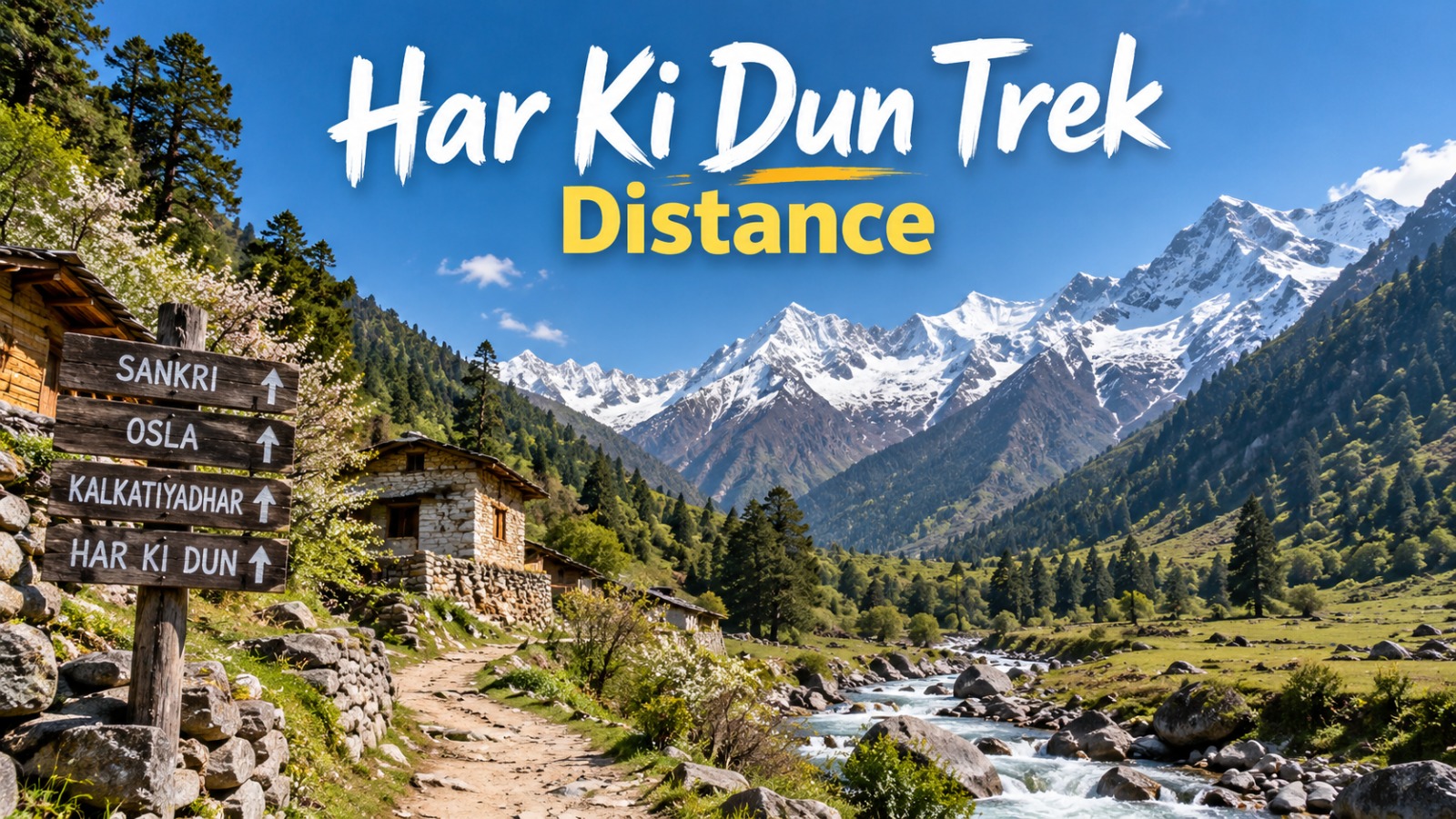
If you search for the Har Ki Dun trek distance, you will find numbers like 34 km, 35 km, 44 km, 47 km and 50 km, sometimes on the same day. That is confusing, especially when you are trying to decide whether this trek suits your fitness.
Here is the good news: these numbers are not wrong. They are measuring slightly different things. In this guide, I will explain why the figures differ, how far you actually walk each day, how the altitude changes, and what that means for your preparation.
How Long Is the Har Ki Dun Trek?
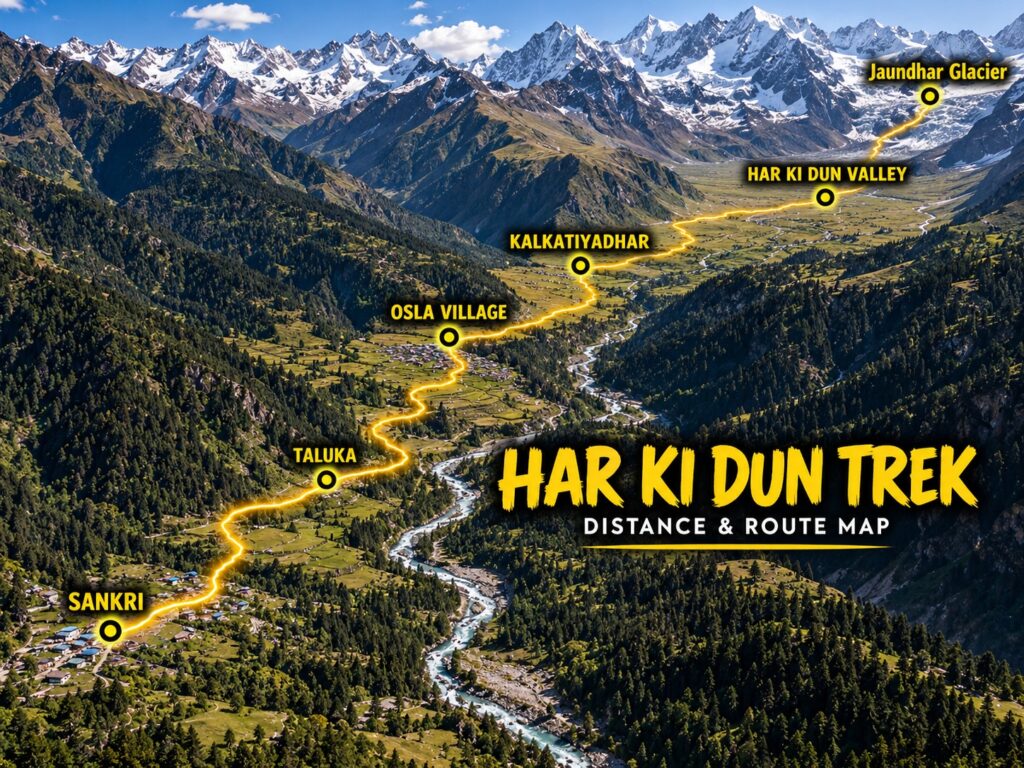
The Har Ki Dun trek is about 47 km round trip when counted from Taluka, the traditional starting point. That is roughly 25 km one way, plus the return. If your operator starts further ahead on the newly built road (near Dharkot or Gangad), the walking distance drops to around 34–35 km. Optional side trips like Marinda Tal add about 5 km for the round trip.
Short version:
- From Taluka: about 47–50 km round trip
- From a forward road head: about 34–35 km round trip
- Valley altitude: about 3,566 m (11,700 ft)
- Typical trek duration: 5–6 days on foot
How Long Is the Har Ki Dun Trek?
The Har Ki Dun trek is about 47 km round trip when counted from Taluka, the traditional starting point. That is roughly 25 km one way, plus the return. If your operator starts further ahead on the newly built road (near Dharkot or Gangad), the walking distance drops to around 34–35 km. Optional side trips like Marinda Tal add about 5 km for the round trip.
Short version:
- From Taluka: about 47–50 km round trip
- From a forward road head: about 34–35 km round trip
- Valley altitude: about 3,566 m (11,700 ft)
- Typical trek duration: 5–6 days on foot
Why Do Different Websites Give Different Distances?
This is the question nobody answers properly, so let me be direct. There are four reasons.
- The road head has moved forward.
Earlier, almost every group began walking at Taluka. In recent years, road work has extended the motorable stretch towards Gangad and Dharkot. Operators who drive further ahead skip several kilometres of walking, so they quote a shorter total, around 34–35 km. Operators who still start at Taluka count the full trail. - Some people count one way, others count both ways.
The distance from the road head to Har Ki Dun is about 25 km one way. A page that says “25 km” and a page that says “50 km” can be describing the same trek. - Side trips are sometimes included.
Marinda Tal (about 2.5 km from the valley) and the track towards the Jaundhar glacier viewpoint (at least 5 km) are optional. Some itineraries include them, some do not. - Itineraries and camps differ.
Some groups camp at Kalkattiyadhar, others at Boslo or near Osla. Different camps mean slightly different daily totals, even on the same trail.
So when you compare trek packages, always ask one simple question: “Where does the walking start and end?”
Har Ki Dun Trek – Route & Walking Distance
A six-day route overview with approximate walking distances and typical travel times for planning your Har Ki Dun Trek.
| Day | Route | Approx. Walking Distance | Typical Time |
|---|---|---|---|
| Day 1 | Drive Dehradun to Sankri | — (drive approx. 190 km) |
9–10 hrs by road |
| Day 2 | Taluka to Seema / Osla | 12–14 km | 5–6 hrs |
| Day 3 | Seema / Osla to Har Ki Dun | 11–12 km | 5–6 hrs |
| Day 4 | Har Ki Dun, optional Marinda Tal, return towards Osla / Kalkattiyadhar | 8–14 km Depending on side trip |
5–8 hrs |
| Day 5 | Osla / Seema to Taluka, drive to Sankri | 12–14 km | 5–6 hrs |
| Day 6 | Drive to Dehradun | — | 9–10 hrs by road |
RouteDrive Dehradun to Sankri
Approx. DistanceApprox. 190 km by road; no trek walking
Typical Time9–10 hours by road
RouteTaluka to Seema / Osla
Approx. Walking Distance12–14 km
Typical Time5–6 hours
RouteSeema / Osla to Har Ki Dun
Approx. Walking Distance11–12 km
Typical Time5–6 hours
RouteExplore Har Ki Dun, optional Marinda Tal, return towards Osla / Kalkattiyadhar
Approx. Walking Distance8–14 km, depending on side trip
Typical Time5–8 hours
RouteOsla / Seema to Taluka, then drive to Sankri
Approx. Walking Distance12–14 km
Typical Time5–6 hours
RouteDrive to Dehradun
Approx. Walking DistanceNo trekking distance
Typical Time9–10 hours by road
Note: Distances and timings are approximate and may vary with the exact campsite, weather, trail conditions, road access, group pace and optional Marinda Tal visit. Confirm the final itinerary before departure.
If your plan starts from the forward road head, Day 2 becomes much shorter, which is why those packages show a lower total.
Altitude Profile: Distance Is Only Half the Story
Distance alone does not tell you how tough a trek is. Here is how the height changes along the way:
Point | Approx. Altitude |
Sankri | ~1,920–1,950 m |
Taluka | ~2,100 m |
Seema / Osla | ~2,450–2,750 m |
Kalkattiyadhar | ~3,000 m |
Har Ki Dun | ~3,566 m |
You gain roughly 1,600 m in total over about 25 km. That is a gradual climb. This is why Har Ki Dun feels long but not brutal, a very different feeling from a short, steep trek.
Har Ki Dun vs Kedarkantha vs Hampta Pass
Compare approximate distance, maximum altitude and the overall trekking experience to understand how these three Himalayan treks differ.
| Trek | Approx. Distance | Max Altitude | Overall Experience |
|---|---|---|---|
| Har Ki Dun | ~47 km | ~3,566 m | Long, gradual, village and valley trek |
| Kedarkantha | ~20 km | ~3,810 m | Shorter, steeper, snow-focused |
| Hampta Pass | ~35 km | ~4,270 m | Higher-altitude trek with a mountain pass crossing |
Approx. Distance~47 km
Max Altitude~3,566 m
ExperienceLong, gradual, villages and valley scenery
Approx. Distance~20 km
Max Altitude~3,810 m
ExperienceShorter, steeper, snow-focused
Approx. Distance~35 km
Max Altitude~4,270 m
ExperienceHigher-altitude route with a pass crossing
What Makes Har Ki Dun Challenging?
Har Ki Dun's main challenge is endurance rather than steepness. Being able to walk 10–12 km a day over consecutive days can be a useful fitness target, but it does not guarantee trek completion. Fitness, altitude response, weather and trail conditions all matter.
What 10–14 km a Day Actually Feels Like
Numbers are easy to read and hard to imagine. A few real-world comparisons:
- 12 km on flat ground takes about 2.5–3 hours at a normal walking pace.
- 12 km on a mountain trail with a backpack and altitude gain takes about 5–6 hours, including rest and photo stops.
- Most of the walking is on forest trails, river paths and village tracks. There is one steep section after Seema that feels tougher than the rest.
Most first-time trekkers describe the final day as the hardest: not because it is steep, but because your legs are already tired and the downhill puts pressure on your knees.
How to Prepare for a 47 km Trek
You do not need to be an athlete, but you do need a plan. Here is a four-week routine you can follow:
Week | Goal | What to Do |
1 | Build the habit | 30 min walk or jog, 5 days |
2 | Add strength | Stairs, squats and lunges, 3 days |
3 | Add endurance | 60 min walk with a 4–5 kg bag |
4 | Simulate the trek | One long 2–3 hour walk, plus light stretching |
Two extra tips:
- Practise downhill walking (stairs down, slopes). Most knee problems on this trek start on descents.
- Break in your trekking shoes before you travel.
Distance, Time and Season: Do They Change Each Other?
The distance on paper stays the same, but the time you need does not:
- April–June: Dry trails and long days make the distance easy to cover.
- Monsoon (July–August): Slippery paths and swollen streams slow everyone down. This is the season to avoid.
- September–November: Clear weather and cool temperatures make long walking days comfortable.
- Early spring and winter: Snow near the top can add hours to the same distance.
Mistakes People Make About Har Ki Dun Distance
- Trusting the lowest number without checking the starting point. A 34 km claim may be perfectly honest, but it only counts walking from a forward road head.
- Underestimating the final descent. 12–14 km downhill on the last day is tougher on knees than most people expect.
- Skipping stamina training because the trek is “easy”. Easy refers to the terrain, not the cumulative distance.
- Packing too heavy. Every extra kilogram feels like three on a long day.
- Forgetting there are no shops after Osla. Carry your essentials and snacks.
Delhi to Delhi: Where Does the Distance Fit In?
If you are travelling from Delhi, the trek is only part of the story. The road journey to Sankri is long (Delhi to Dehradun is about 5–6 hours and Dehradun to Sankri about 9–10 hours), so a complete Delhi to Delhi trip usually takes about 8 days. You can see how the route is organised on our Har Ki Dun Trek page and check dates and inclusions on the Har Ki Dun Trek Package page.
Frequently Asked Questions
What is the total distance of the Har Ki Dun trek?
About 47 km round trip from Taluka. Some itineraries that start from a forward road head are closer to 34–35 km.
What is the one-way distance to Har Ki Dun?
Roughly 25 km from the traditional starting point.
How far is Sankri from Har Ki Dun?
There is a short drive from Sankri to Taluka (around 10–12 km), followed by about 25 km on foot to the valley.
How many km do you walk per day?
Usually 10–14 km on the main trekking days, with a shorter or longer day depending on the plan.
How many days does the trek take?
Around 5–6 days from Sankri and back, or about 8 days from Delhi to Delhi.
Is Marinda Tal included in the total distance?
Usually not. It adds around 5 km round trip as a side trip.
Is Har Ki Dun suitable for beginners given the distance?
Yes, if you prepare. The gradient is gentle, so stamina matters more than strength.
Is Har Ki Dun longer than Kedarkantha?
Yes. Har Ki Dun is about 47 km versus around 20 km for Kedarkantha, though Kedarkantha is steeper and reaches a higher summit.
Final Thoughts
The Har Ki Dun trek distance is not one fixed number. It is a range that depends on where the walking starts and which side trips you add. If you remember just one thing, remember this: ask your operator where the trek begins and ends, then plan your fitness around about 10–14 km per day.
Ready to plan? Explore the route on our Har Ki Dun Trek page or view dates and pricing on the Har Ki Dun Trek Package page.